
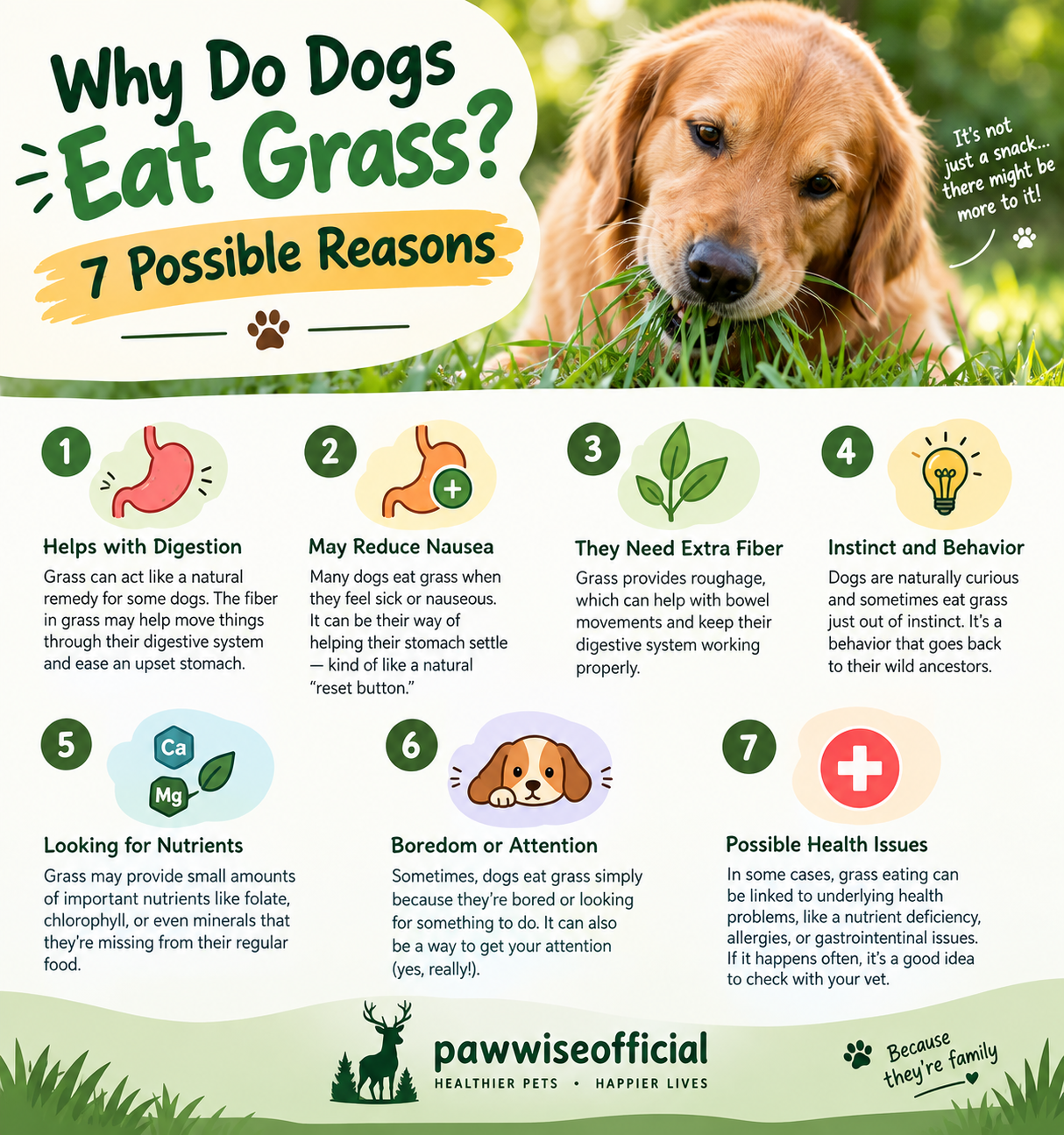
Have you ever taken your dog outside, only to watch them stop halfway through the yard and start munching on grass?
You look at them and think, “Why is my dog eating grass?”
Then maybe another question pops into your head, “Is my dog sick?” Or, “Do dogs eat grass when they have an upset stomach?” And if your dog suddenly starts eating grass more often than usual, it’s pretty easy to start worrying.
The good news is, dogs eating grass is a fairly common behavior. Some dogs take a few bites during a walk and move on, while others seem to search for the perfect patch of fresh green grass every time they go outside.
But why do they do it?
Is your dog trying to make themselves vomit? Could they be hungry? Are they bored? Maybe they like the taste, or maybe something else is going on.
Honestly,, there isn’t one simple answer.
Dogs eat grass for several possible reasons, and most of the time, occasional grass eating isn’t something that should immediately send you into panic mode. Still, it’s important to pay attention to how much grass your dog is eating and whether they’re showing any other unusual symptoms.
So, let’s get into it.
1. Your dog may simply like the taste
Yes,, sometimes the simplest explanation really is the right one.
Your dog may eat grass because they actually like the taste.
Dogs experience the world differently from us. They sniff everything, lick things, chew things, and taste things they find interesting. Fresh grass has a smell, texture, and taste that some dogs clearly enjoy.
Have you noticed your dog going straight for a particular patch of grass?
Maybe they walk past one area without caring, then suddenly stop at another spot and start nibbling away. If that happens regularly, your dog may simply prefer the taste or texture of that particular grass.
Some dogs seem especially interested in young, soft grass, particularly when it’s fresh or slightly damp.
If your dog eats a small amount of grass and then goes back to normal, there may not be much to worry about.
Are they still playful?
Are they eating their normal meals?
Are they drinking water normally?
Are their bowel movements normal?
If the answer is yes to all of those questions, the grass eating may simply be one of your dog’s funny little habits.
Dogs can have some pretty strange habits, after all.
2. Your dog could be bored
Could boredom be the reason your dog is eating grass?
It certainly could be.
Dogs need physical exercise, but they also need mental stimulation. If a dog spends a lot of time outside with nothing interesting to do, they may start finding their own entertainment.
And what’s sitting right in front of them?
Grass.
Chewing grass can give a bored dog something to investigate. They can sniff it, pull at it, chew it, and spend a few minutes exploring.
Think about your dog’s routine.
Do they eat grass mostly when they’re outside alone?
Do they wander around without much purpose?
Do they seem restless?
Are they constantly looking for something to chew?
If so, boredom might be contributing to the behavior.
Try giving your dog a little more to do. A longer walk, a game of fetch, a puzzle toy, basic obedience training, or even a few minutes of supervised sniffing can make a difference.
Sometimes,, your dog doesn’t need anything complicated. They may just need something interesting to keep their brain busy.
3. They may enjoy chewing grass
Have you ever noticed how some dogs seem to chew absolutely everything?
Shoes, toys, cardboard boxes, sticks, blankets… if they can get their mouth around it, they want to investigate it.
Grass can be similar.
The texture of grass may simply feel interesting to your dog. For puppies in particular, chewing and exploring objects with their mouths is a normal part of growing and learning about their surroundings.
A puppy may nibble grass, chew leaves, mouth a toy, and then try to chew something they definitely shouldn’t, like your favorite pair of shoes.
Sound familiar?
If your dog is young and otherwise healthy, grass eating may simply be another form of exploration.
That doesn’t mean you should let them eat unlimited amounts, though. It’s still important to supervise them and make sure they aren’t eating plants that could be poisonous.
And if you know the grass has been treated with lawn chemicals, keep your dog away from it.
4. Your dog may have an upset stomach
This is probably the question that worries dog owners the most:
“Is my dog eating grass because their stomach hurts?”
It’s possible, but the answer isn’t as simple as you may have heard.
There’s a common belief that dogs eat grass because they feel sick and want to make themselves vomit. While some dogs may vomit after eating grass, that doesn’t mean every dog eats grass specifically to throw up.
In fact, many dogs eat grass and don’t vomit afterward.
So, if your dog takes a few bites of grass and then happily carries on with their day, that alone doesn’t necessarily mean they have an upset stomach.
However, things become more concerning when grass eating happens along with other symptoms.
Is your dog vomiting repeatedly?
Do they have diarrhea?
Have they stopped eating?
Are they drooling more than usual?
Do they seem unusually tired?
Are they acting uncomfortable or restless?
If your dog is showing these signs, don’t assume that eating grass is the problem, or that grass will fix it. There could be an underlying stomach or digestive issue that needs attention.
The key is to look at the whole picture, not just the grass.
5. They could be looking for extra fiber
Another possible reason for why dogs eat grass is fiber.
Grass contains some fiber, and dogs do need fiber as part of a healthy, balanced diet. However, grass shouldn’t be treated as a reliable source of nutrition for your dog.
If your dog is constantly eating grass, you might start wondering, “Could my dog be missing something in their diet?”
It’s a reasonable question.
But grass eating alone isn’t enough to tell you that your dog has a nutritional deficiency.
Instead, take a look at what your dog is actually eating.
Is their food complete and balanced?
Is it appropriate for their age and size?
Have you recently changed their food?
Are they getting lots of table scraps or treats?
Have their eating habits changed recently?
If you’re concerned about your dog’s nutrition, it’s much better to speak with a veterinarian than to start adding random supplements to their diet.
A good diet should provide the nutrients your dog needs without them having to rely on backyard grass.
6. It may simply be natural dog behavior
Here’s something worth remembering,, dogs don’t always do things for the same reasons humans do.
They sniff, dig, chew, explore, roll around in questionable things, and occasionally eat things that make us wonder what on earth they were thinking.
Eating plants can be part of normal exploratory behavior.
Your dog may be following a scent, investigating a new area, or simply enjoying the experience of chewing something growing outdoors.
Have you ever noticed that your dog has a little routine outside?
Maybe they walk around first, sniff everything, find their favorite patch of grass, take a few bites, and then continue their walk.
If your dog does this occasionally and seems perfectly healthy, it may just be part of their normal behavior.
That doesn’t mean every outdoor plant is safe, though. Some plants can be toxic to dogs, and grass treated with certain chemicals can also be dangerous.
So, natural behavior still needs a little supervision.
7. Your reaction may be encouraging the behavior
This one is easy to overlook.
What do you do when your dog starts eating grass?
Do you immediately rush over?
Do you say, “No! Stop eating that!”
Do you pull them away?
For some dogs, all that attention can make the behavior more interesting.
Dogs quickly learn which behaviors get a reaction from their owners. Even negative attention can sometimes become rewarding because, from your dog’s point of view, you suddenly became very interested in them.
Of course, this doesn’t mean your dog is eating grass just to annoy you.
But if you notice that your dog mainly eats grass when you’re watching, it’s something to consider.
Instead of making a huge fuss, calmly redirect them. Call them over, offer a toy, practice a simple command, or move them toward another activity.
Could this reduce the habit?
Sometimes, yes.
Is eating grass safe for dogs?
Now for the really important question:
Is grass safe for dogs?
The grass itself isn’t necessarily dangerous, but the environment around it can be.
For example, do you know if the lawn has been treated with pesticides, herbicides, fertilizers, or other chemicals?
If you don’t know, it’s safest to stop your dog from eating that grass.
You should also be careful in public areas where other animals have been. Grass contaminated with animal feces can potentially expose your dog to parasites or other harmful organisms.
And what about weeds or plants growing among the grass?
Some plants can be toxic to dogs.
That’s why letting your dog freely eat anything they find outside isn’t a great idea.
A little supervision can go a long way.
Should you stop your dog from eating grass?
Not always.
If your dog occasionally eats a few bites of grass from a clean, untreated area and otherwise behaves normally, you may not need to worry about every single bite.
But should you allow them to eat huge amounts?
Probably not.
If your dog is constantly eating grass, swallowing it quickly, or searching for grass every time they go outside, it’s worth paying closer attention.
You can calmly redirect them, offer another activity, or work on a “leave it” command.
This command can be incredibly useful, not just for grass, but for other things your dog may find outside.
Because let’s be honest,, dogs don’t always have the best judgment when it comes to what belongs in their mouths.
When should you call a veterinarian?
Occasional grass eating, by itself, usually isn’t an emergency.
But what if your dog’s behavior suddenly changes?
That’s when you should take it more seriously.
Contact your veterinarian if your dog is eating large amounts of grass and also has symptoms such as:
- Repeated vomiting
- Ongoing diarrhea
- Blood in vomit or stool
- Loss of appetite
- Unusual or severe tiredness
- Excessive drooling
- Signs of stomach or abdominal pain
- A swollen or bloated abdomen
- Repeated gagging or retching
- Difficulty breathing
- Sudden changes in behavior
- Significant discomfort or restlessness
What if your dog is repeatedly trying to vomit but nothing comes up?
That can be particularly concerning, especially if the abdomen looks swollen. In that situation, seek veterinary help promptly.
The important thing is not to assume that grass eating is causing everything.
Sometimes, the grass is just something you noticed because your dog is already feeling unwell.
What can you do if your dog keeps eating grass?
If your dog seems obsessed with grass, don’t immediately assume something terrible is happening.
Instead, become a little detective.
When does your dog eat grass?
Is it during walks?
Only in the backyard?
Before meals?
After meals?
When they’re bored?
When they’re nervous?
Do they take two or three bites, or do they sit down and eat a whole mouthful?
Do they vomit afterward?
Is their appetite normal?
Are their stools normal?
Are they still excited about walks and playtime?
These small details can tell you much more about what’s happening.
You can also make your dog’s daily routine more engaging. Give them regular exercise, play with them, use safe chew toys, and add short training sessions throughout the day.
If you think their diet may be part of the issue, speak with your veterinarian before making major food changes or adding supplements.
Why is my dog eating grass all of a sudden?
If your dog has eaten grass occasionally for years, there may be nothing unusual about it.
But what if they suddenly start eating grass much more often?
That deserves a little more attention.
A sudden change in behavior can sometimes happen because of boredom, changes in routine, a new environment, or simply increased interest in something outdoors.
But if the change comes with vomiting, diarrhea, poor appetite, lethargy, pain, or other unusual symptoms, it’s better to speak with your veterinarian.
You know your dog’s normal behavior better than anyone.
If something feels different, don’t ignore that feeling.