Have you ever come home after a long day, only to find your dog staring at you with that look that clearly says, “So… are we going outside or what?”
If you have, you’re definitely not alone.
One of the most common questions dog owners ask is, how much exercise does a dog actually need every day? And honestly, there isn’t one simple answer.
Some dogs are perfectly happy with a couple of relaxed walks and some playtime. Others seem to have an endless supply of energy and could probably run around the yard all afternoon without getting tired.
Your dog’s age, breed, size, health, fitness level, and personality all matter.
A young Border Collie, for example, is going to have very different exercise needs from an older Shih Tzu. And even two dogs of the same breed can be completely different.
The good news is, once you understand your dog’s needs, creating a healthy exercise routine becomes much easier.
So, let’s talk about how much exercise your dog really needs, what counts as exercise, the signs they’re getting too little or too much, and a few easy ways to keep them active without turning every day into a marathon.
How Much Exercise Does a Dog Need Every Day?
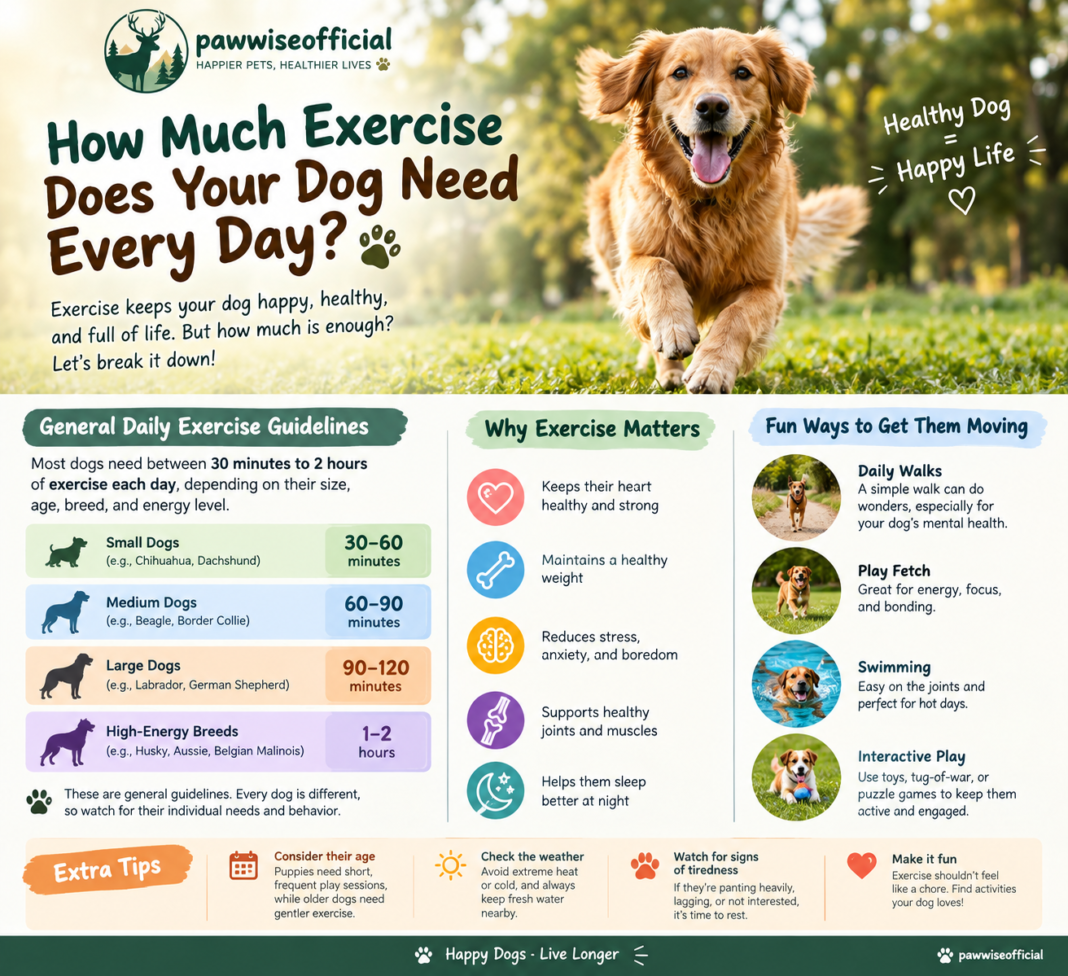
As a general starting point, many healthy adult dogs benefit from around 30 minutes to 2 hours of physical activity each day.
But don’t treat that range like a strict rule carved in stone.
Some dogs need less, while energetic working and sporting breeds may need considerably more. Puppies, senior dogs, and dogs with certain health conditions may also need a different approach.
The best exercise routine is one that fits your individual dog.
For some dogs, exercise might include a morning walk, a game of fetch in the evening, and a little training during the day.
For another dog, it could mean several short walks, gentle indoor play, and plenty of sniffing and exploring.
And yes, sniffing counts as something useful too.
Dogs experience the world through their noses. A walk where your dog stops every few seconds to investigate a smell might feel slow to you, but for them, it’s like scrolling through an endless feed of interesting information.
Why Is Daily Exercise So Important for Dogs?
Exercise isn’t just about helping your dog burn calories.
It’s a big part of keeping them physically and mentally healthy.
Regular movement can help support healthy muscles, joints, cardiovascular fitness, and weight management. It can also give dogs an outlet for all that natural energy they have.
And then there’s the mental side.
A dog who spends the entire day sitting around with nothing to do may eventually create their own entertainment.
Unfortunately, their idea of entertainment might be chewing your shoes, digging through the trash, barking at absolutely nothing, or rearranging the cushions on your sofa.
Not exactly the home makeover you had in mind,, right?
Regular exercise and mental stimulation can help reduce boredom and give your dog something positive to focus on.
Exercise Needs by Age
Your dog’s age is one of the first things you should consider when deciding how much exercise they need.
Puppies Need Short, Gentle Activities
Puppies are adorable little balls of energy, but that doesn’t mean they should be exercising for hours.
Their bodies are still developing, and their bones and joints need time to grow.
Instead of long, intense workouts, puppies usually do better with short walks, gentle play, basic training, and supervised exploration.
You might play with a toy for a few minutes, practice simple commands, let your puppy explore a safe area, and then give them time to rest.
And don’t underestimate how much sleep puppies need.
A puppy that suddenly becomes extra bitey, cranky, or completely wild may not need another game of fetch. They may simply be tired.
Sometimes the answer is a nap,, not more exercise.
Adult Dogs Usually Need Consistent Activity
Adult dogs are generally ready for a more regular exercise routine.
Depending on their breed and energy level, this might mean anywhere from 30 minutes to a couple of hours of activity throughout the day.
You don’t have to do it all at once.
In fact, splitting exercise into two or three sessions can work really well.
For example:
- A morning walk
- A short training session during the afternoon
- Evening playtime or another walk
This gives your dog several opportunities to move and interact with you.
Senior Dogs Still Need Exercise
Getting older doesn’t mean your dog should stop moving.
In fact, gentle, appropriate exercise can be very helpful for many senior dogs.
However, you may need to slow things down.
Your older dog might prefer a relaxed walk around the neighborhood instead of a long hike. Gentle swimming or short play sessions may also be easier on aging joints.
Pay attention to how your dog feels during and after exercise.
If they’re limping, struggling to stand, becoming unusually tired, or showing signs of pain, don’t push them.
A veterinarian can help you figure out what type and amount of activity is appropriate.
How Breed Affects Your Dog’s Exercise Needs
Breed can give you a useful clue about your dog’s energy level.
High-Energy Dogs
Some breeds were literally developed to work, run, herd, retrieve, or stay active for long periods.
Border Collies, Australian Shepherds, Belgian Malinois, Siberian Huskies, and many sporting breeds can have very high exercise needs.
A quick walk around the block may not be enough for these dogs.
They often need a combination of physical exercise and mental stimulation.
Try activities such as:
- Fetch
- Hiking
- Running
- Agility
- Scent games
- Obedience training
- Swimming
- Interactive toys
- Long sniffing walks
For these dogs, keeping their brain busy can be just as important as making their legs move.
Medium-Energy Dogs
Many popular family dogs fall somewhere in the middle.
They may enjoy a couple of good walks each day, along with games and training.
You don’t necessarily need to entertain them every second. What matters is giving them enough opportunities to move, explore, and interact.
Lower-Energy Dogs
Some dogs are naturally more relaxed.
They may be perfectly happy with shorter walks, gentle games, and plenty of rest.
But low-energy doesn’t mean no-energy.
Even a small or laid-back dog benefits from regular movement.
And remember, small dogs aren’t automatically low-energy. Some tiny dogs can run circles around much larger breeds,, literally.
How Do You Know If Your Dog Isn’t Getting Enough Exercise?
Your dog can’t exactly sit you down for a meeting and say, “We need to discuss my daily activity levels.”
Instead, they’ll usually show you through their behavior.
Here are some signs your dog may need more physical or mental stimulation.
1. They’re Constantly Restless
Does your dog pace around the house, repeatedly bring you toys, or follow you everywhere looking for something to do?
They may have extra energy that isn’t being used.
2. They’re Becoming Destructive
Chewing furniture, digging through things, stealing socks, or destroying toys can sometimes be linked to boredom.
Of course, destructive behavior can have many causes, including anxiety and separation-related problems, so exercise isn’t always the complete solution.
Still, a bored dog is often a creative dog,, and their creativity isn’t always convenient for you.
3. They’re Barking for Attention
Some dogs bark because they’re anxious, excited, alerting you to something, or trying to communicate.
But if your dog constantly demands attention and seems unable to settle, adding more appropriate activity and enrichment may help.
4. They’re Gaining Weight
Exercise is only one piece of the weight-management puzzle. Diet, age, metabolism, and health all matter too.
But if your dog is gaining unnecessary weight, it’s worth looking at both their food intake and daily activity.
5. They Seem Bored
Sometimes the signs are simple.
Your dog keeps wandering around, sighing dramatically, staring at you, and bringing you the same toy for the hundredth time.
Yep,, they might be bored.
Can a Dog Get Too Much Exercise?
Absolutely.
It’s easy to think that if some exercise is good, more must be better.
That’s not always true.
Overdoing exercise can leave your dog exhausted and may increase the risk of soreness or injury, particularly in puppies, senior dogs, overweight dogs, and dogs with existing health problems.
Watch for signs such as:
- Excessive or unusual panting
- Limping
- Stiffness
- Reluctance to keep walking
- Sore or damaged paw pads
- Extreme tiredness
- Trouble getting up
- Changes in normal behavior
If your dog seems uncomfortable, stop the activity and let them rest.
And be especially careful during hot weather.
Dogs can overheat quickly, and some breeds are more vulnerable than others. Avoid intense exercise during the hottest part of the day, provide fresh water, and choose cooler times for walks.
Don’t Forget Mental Exercise
Here’s something every dog owner should remember:
Exercise isn’t only about running.
Your dog’s brain needs a workout too.
Mental stimulation can be incredibly valuable, especially for intelligent or high-energy dogs.
You can give your dog a mental workout with simple activities like:
Puzzle Toys
Food puzzles make your dog think about how to reach the reward.
Training
Teaching your dog a new trick can be surprisingly tiring.
Try commands such as “place,” “touch,” “leave it,” or even fun tricks like spinning or putting a toy away.
Scent Games
Hide a few treats around a safe room and let your dog search for them.
For a dog, following a scent is serious business.
Sniff Walks
Instead of rushing through the walk, allow your dog time to stop and smell things.
It may take longer,, but your dog gets more mental enrichment from the experience.
Does Playing at Home Count as Exercise?
Yes.
You don’t always need a huge backyard or a hiking trail to give your dog some activity.
Indoor games can be especially useful on rainy days or when the weather outside is too hot.
Try:
- Tug-of-war
- Fetch down a hallway
- Hide-and-seek
- Training games
- Treat searches
- Puzzle toys
- Interactive play
Just make sure the environment is safe and there isn’t anything slippery or dangerous that could cause an injury.
Does Having a Backyard Mean Your Dog Gets Enough Exercise?
Not necessarily.
This is something many dog owners assume.
They think, “My dog has a backyard, so they can exercise whenever they want.”
But dogs don’t always exercise themselves.
Your dog may go outside, sniff around for five minutes, lie down, and wait for you to come back.
A backyard is a great resource, but active play and interaction can make it much more useful.
Throw a ball, play a gentle game, practice recall, or create a simple scent game.
Sometimes your dog doesn’t need more space,, they need a reason to move.
What If Your Dog Doesn’t Like Walks?
Not every dog loves going for walks.
Some dogs are nervous around traffic, unfamiliar people, loud noises, or other animals.
If your dog refuses to walk, don’t automatically assume they’re being stubborn.
Try making the experience easier.
Choose quieter areas, keep the first walks short, use positive reinforcement, and allow your dog to explore at their own pace.
You can also provide exercise at home through games and training.
However, if your dog suddenly stops wanting to walk when they previously enjoyed it, pay attention.
A sudden change could be related to pain, injury, illness, or another problem, and it’s worth discussing with your veterinarian.
How to Create a Simple Daily Exercise Routine
If your dog isn’t currently getting much exercise, start slowly.
Don’t suddenly take a dog that normally walks for 10 minutes and expect them to complete a two-hour hike.
Gradually increase activity as their fitness improves.
A simple routine for a healthy adult dog might look something like this:
Morning:
A 20–30 minute walk with plenty of sniffing.
Afternoon:
10–15 minutes of training, indoor play, or a puzzle toy.
Evening:
Another walk or an active game, depending on your dog’s energy level.
Throughout the day:
Short opportunities for training, exploring, chewing, and mental stimulation.
Of course, this is only an example.
Your dog’s routine should be adjusted according to their age, breed, health, fitness, and personality.
What About Exercise in Hot Weather?
If you live somewhere with hot summers, this deserves extra attention.
A walk that feels comfortable to you may be too much for your dog.
Try exercising during the cooler parts of the day, usually early morning or later in the evening.
Always provide access to fresh water, and be careful with hot pavement, which can burn your dog’s paw pads.
Watch for warning signs of overheating, including heavy panting, weakness, drooling, confusion, vomiting, or collapse.
If you suspect your dog is overheating, treat it as an emergency and contact a veterinarian immediately.
When Should You Talk to Your Veterinarian?
If you’re unsure about your dog’s exercise needs, especially if they have a medical condition or are significantly overweight, your veterinarian can help.
It’s particularly important to ask for professional guidance if your dog:
- Has difficulty breathing during normal activity
- Develops a limp
- Seems painful
- Tires much faster than usual
- Suddenly stops wanting to exercise
- Has trouble walking or climbing stairs
- Is recovering from an injury or surgery
- Is elderly or has mobility problems
Don’t try to “exercise through” pain.
Your dog’s body language is telling you something, and it’s better to listen.