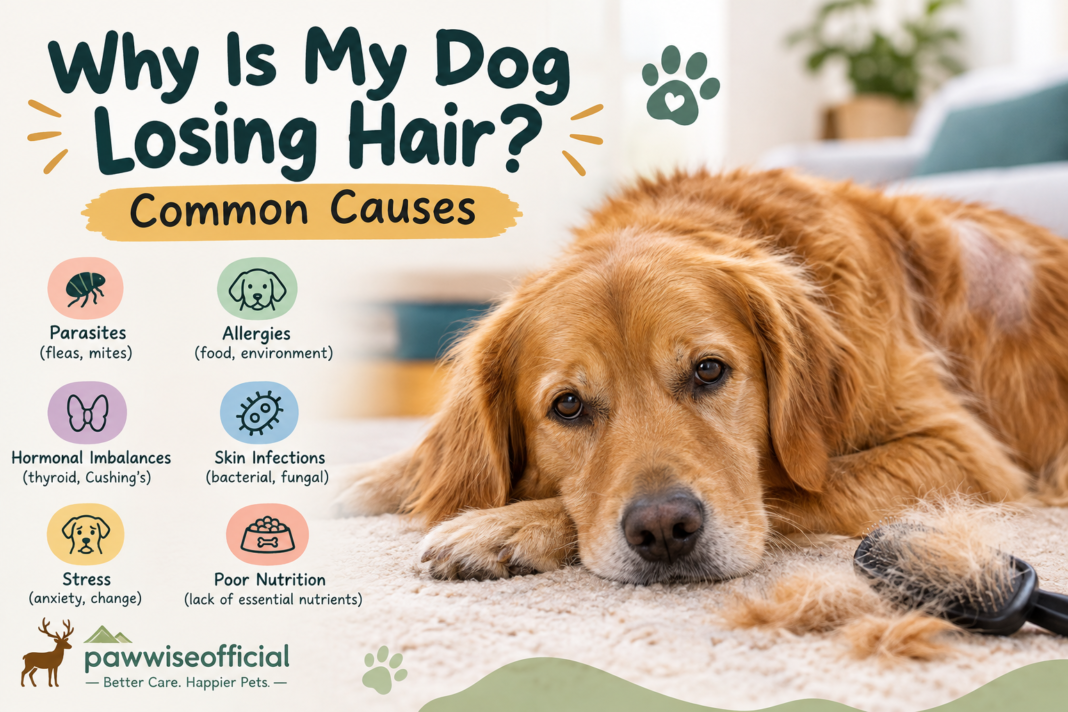
Finding a little dog hair on your sofa is completely normal.
Finding it everywhere, though, is a different story.
If your dog suddenly seems to be shedding much more than usual, or you’ve noticed bald spots, thinning fur, flaky skin, or patches of missing hair, you’re probably wondering, “Why is my dog losing hair?”
And honestly, it can be worrying.
Dog hair loss, also called alopecia, can happen for many different reasons. Sometimes, it’s nothing more than normal seasonal shedding. Other times, excessive shedding can be a sign of allergies, parasites, skin irritation, hormonal problems, nutritional issues, or another underlying health condition.
So how do you know what’s normal and what deserves a closer look?
Let’s break down the most common causes of hair loss in dogs, the signs to watch for, and when it’s time to call your veterinarian.
Is It Normal for Dogs to Lose Hair?
Yes, some hair loss is completely normal.
Dogs naturally shed old or damaged hair to make room for new growth. Some breeds shed a little, while others seem to leave a furry reminder of themselves on every piece of furniture in the house.
Seasonal shedding can also make a big difference. Depending on the breed and environment, some dogs shed more heavily during certain times of the year.
But there’s an important difference between normal shedding and abnormal hair loss.
Normal shedding usually doesn’t cause obvious bald patches or irritated skin.
If your dog’s coat is becoming noticeably thinner, hair is falling out in clumps, or you can see bald areas, something else may be going on.
And if your dog is scratching, licking, biting, or rubbing their skin constantly,, that’s another clue worth paying attention to.
1. Fleas and Other Parasites
One of the first things to consider when your dog is losing hair is parasites.
Fleas are especially common and can cause intense itching. Some dogs are allergic to flea saliva, which means even a small number of fleas can cause a surprisingly strong reaction.
Your dog may scratch, lick, or chew certain areas repeatedly, eventually damaging the skin and pulling out hair.
You might notice hair loss around the:
- Base of the tail
- Lower back
- Hind legs
- Belly
- Inner thighs
And here’s the frustrating part, you may not always see fleas.
A dog can have a flea problem even when you don’t spot an actual flea crawling through the fur.
Other parasites, including certain types of mites, can also cause hair loss and irritated skin.
If you suspect parasites, your veterinarian can check your dog’s skin and recommend an appropriate treatment.
2. Allergies
Just like people, dogs can develop allergies.
Allergies are a common reason for itchy skin and hair loss in dogs.
Your dog’s allergy might be related to something in their environment, such as pollen, dust, mold, or certain plants. Food allergies or sensitivities can also contribute to skin problems in some dogs.
Instead of simply losing hair, many allergic dogs become extremely itchy.
They may:
- Scratch frequently
- Lick their paws
- Chew their legs
- Rub their face
- Shake their ears
- Develop red or irritated skin
Over time, all that scratching and licking can damage the coat and cause noticeable hair loss.
If your dog seems constantly itchy, don’t just assume they’re going through a normal shedding season.
There may be an underlying cause that needs attention.
3. Skin Infections
Bacterial and fungal infections can affect your dog’s skin and coat.
A common example is ringworm, which is a fungal infection rather than an actual worm.
Ringworm can cause circular areas of hair loss, redness, scaling, or crusting. It can also spread to other animals and, in some cases, people.
Other skin infections can cause symptoms such as:
- Redness
- Odor
- Scabs
- Flaky skin
- Moist or irritated areas
- Excessive itching
- Hair loss
If your dog’s skin looks unusual, especially if the hair loss is spreading, it’s a good idea to have them examined rather than trying random treatments at home.
4. Your Dog May Be Dealing With Mites
Mites are tiny parasites that can cause significant skin problems.
One condition people often hear about is sarcoptic mange, which can cause intense itching, redness, crusting, and hair loss.
Another type, demodectic mange, is associated with an overgrowth of Demodex mites. It can cause localized or widespread hair loss and skin changes.
Mange isn’t something you can reliably diagnose just by looking at your dog’s coat.
A veterinarian may need to examine skin samples under a microscope or perform other tests.
The good news is that many mite-related conditions can be treated, but the treatment depends on what’s actually causing the problem.
5. Hormonal or Other Medical Problems
Sometimes, hair loss isn’t primarily a skin problem.
Certain medical conditions can affect the way a dog’s hair grows.
For example, hormonal disorders such as hypothyroidism or Cushing’s disease may be associated with changes in the skin and coat.
A dog with a hormonal condition might also show other changes, such as:
- Weight changes
- Increased thirst
- Increased urination
- Low energy
- Changes in appetite
- A thinner coat
- Slow hair regrowth
Hair loss caused by an underlying medical condition can look quite different from ordinary shedding.
If your dog’s coat has changed noticeably and you can’t find an obvious explanation, a veterinary checkup is worthwhile.
Sometimes the fur is simply the first thing that makes an owner realize something else has changed.
6. Poor Nutrition Can Affect the Coat
Your dog’s coat can tell you quite a bit about their overall health.
A balanced, complete diet provides the nutrients dogs need to support healthy skin and hair.
If a dog’s nutritional needs aren’t being met, their coat may become dry, dull, brittle, or thin.
Protein, essential fatty acids, vitamins, and minerals all play roles in maintaining healthy skin and fur.
That doesn’t mean every dog with hair loss needs supplements.
In fact, adding random supplements without knowing what your dog actually needs isn’t always a good idea.
If you’re concerned about your dog’s diet, talk with your veterinarian before making major changes or adding supplements.
A healthy coat starts from the inside,, but the solution isn’t always sitting in a bottle of vitamins.
7. Stress and Anxiety
Believe it or not, stress can sometimes affect a dog’s skin and coat.
Dogs can experience stress for many reasons, including major changes in their environment, separation, unfamiliar situations, loud noises, or changes in their routine.
Some stressed dogs repeatedly lick or chew certain parts of their body. This behavior can eventually cause hair loss and skin irritation.
You may notice your dog licking their paws or legs over and over again, especially when they’re anxious or bored.
However, don’t automatically assume that licking means your dog is stressed.
Pain, allergies, parasites, and skin infections can cause similar behavior.
It’s important to rule out physical causes first.
8. Excessive Licking or Scratching
Sometimes, the hair loss itself isn’t the original problem.
Your dog may start scratching or licking because something is irritating their skin, and the repeated behavior causes the hair to disappear.
Think about it this way, the missing fur is often a symptom, not the actual disease.
Your dog could be reacting to:
- Fleas
- Allergies
- Dry skin
- Pain
- Infections
- Parasites
- Environmental irritants
If you keep treating the hair loss without figuring out why your dog is scratching or licking, the problem may simply keep coming back.
That’s why identifying the underlying cause matters.
9. Seasonal Shedding
Now for the reassuring possibility, maybe your dog is simply shedding.
Many dogs experience periods of heavier shedding as their coats adjust to seasonal changes.
During these times, you might notice:
More hair on your furniture.
More hair on your clothes.
More hair in the vacuum cleaner.
And somehow, even more hair on your clothes five minutes after vacuuming.
That’s normal for many dogs.
Regular brushing can help remove loose fur before it ends up all over your home. The type of brush you use should depend on your dog’s coat.
A short-haired dog, a double-coated dog, and a long-haired dog don’t necessarily need the same grooming routine.
10. Genetics and Breed Can Play a Role
Some dogs are naturally more prone to certain coat and skin conditions.
Breed genetics can influence the thickness of the coat, shedding patterns, allergies, and susceptibility to particular skin disorders.
Some dogs may also develop age-related thinning or coat changes.
So if your dog has always had a certain coat pattern, it may simply be part of their genetics.
But a new or sudden change deserves more attention.
If your dog’s coat has recently become much thinner than usual, don’t assume it’s simply their breed.
What Does Abnormal Hair Loss Look Like?
Not every loose hair means something is wrong.
But certain changes are worth noticing.
Contact your veterinarian if you see:
- Bald patches
- Sudden or severe shedding
- Red or inflamed skin
- Scabs or sores
- Persistent itching
- Constant licking or chewing
- A strong skin odor
- Circular areas of hair loss
- Changes in skin color
- Hair loss that keeps spreading
- Hair that isn’t growing back
Also pay attention to your dog’s overall behavior.
Are they eating normally?
Are they sleeping normally?
Do they seem comfortable?
Have you noticed changes in their weight or energy?
Those details can help your veterinarian understand the bigger picture.
Why Is My Dog Losing Hair Around Their Eyes or Ears?
Hair loss around the face can have several possible causes.
Parasites, allergies, infections, irritation, and excessive scratching can all affect these areas.
Dogs may also rub their faces against carpets, furniture, or their paws when something is bothering them.
Because the eyes and ears are sensitive areas, avoid putting human creams, oils, or medications on them unless your veterinarian specifically recommends it.
A seemingly harmless home remedy can sometimes make irritation worse.
Why Is My Dog Losing Hair on Their Back?
Hair loss on the back, particularly around the tail area, can sometimes be associated with fleas or flea allergy dermatitis.
But there are other possibilities too, including allergies, skin infections, hormonal problems, and excessive scratching.
The location of the hair loss can give your veterinarian useful clues, but it usually isn’t enough to identify the cause by itself.
That’s why an examination matters if the problem continues.
Can Changing Dog Shampoo Cause Hair Loss?
It can contribute to skin irritation in some dogs.
Dogs have different skin needs from humans, and products made for people may be too harsh for them.
If you recently changed grooming products and your dog’s skin became irritated afterward, stop using the new product and discuss the situation with your veterinarian if symptoms continue.
For regular bathing, choose products specifically formulated for dogs.
And remember, more baths aren’t necessarily better.
Over-bathing can sometimes dry or irritate the skin.
Should You Be Worried About Your Dog’s Hair Loss?
Not necessarily.
A little extra shedding can be completely normal.
But if the hair loss is sudden, severe, patchy, or accompanied by itching, redness, sores, odor, or other changes, it’s worth getting professional advice.
The earlier you identify the cause, the easier it may be to manage the problem.
And please don’t feel bad if you can’t figure it out yourself.
There are a lot of possible causes of dog hair loss, and several conditions can look surprisingly similar.
That’s what veterinary examinations and diagnostic tests are for.
How Can You Help Keep Your Dog’s Coat Healthy?
You don’t need a complicated beauty routine to support a healthy coat.
Start with the basics:
Feed a Balanced Diet
Choose a complete and balanced dog food appropriate for your dog’s life stage and nutritional needs.
Brush Regularly
Brushing removes loose hair, helps prevent some tangles, and gives you a chance to notice changes in your dog’s skin.
Keep Parasite Prevention Up to Date
Use parasite prevention recommended by your veterinarian, especially if your dog spends time outdoors or around other animals.
Don’t Ignore Itching
Occasional scratching is normal.
Constant scratching isn’t.
Check the Skin During Grooming
Look for redness, lumps, scabs, flakes, unusual smells, or areas where the hair is becoming thinner.
A few minutes of checking can help you notice changes early.
When Should You Take Your Dog to the Vet?
If your dog is losing hair and you aren’t sure why, a veterinarian is the safest person to ask.
Definitely seek professional advice if the hair loss is accompanied by severe itching, open wounds, infection, pain, lethargy, appetite changes, weight changes, or rapid spreading of bald patches.
Your veterinarian may examine the skin and coat, look for parasites, and recommend additional testing if needed.
Treatment depends entirely on the cause.
Flea-related hair loss, allergies, infections, mites, hormonal conditions, and nutritional problems don’t all have the same solution.
So, try not to diagnose your dog based on a Google search alone,, even if you’ve already spent an hour looking at pictures of “dog bald spots” at two in the morning.
We’ve all been there.