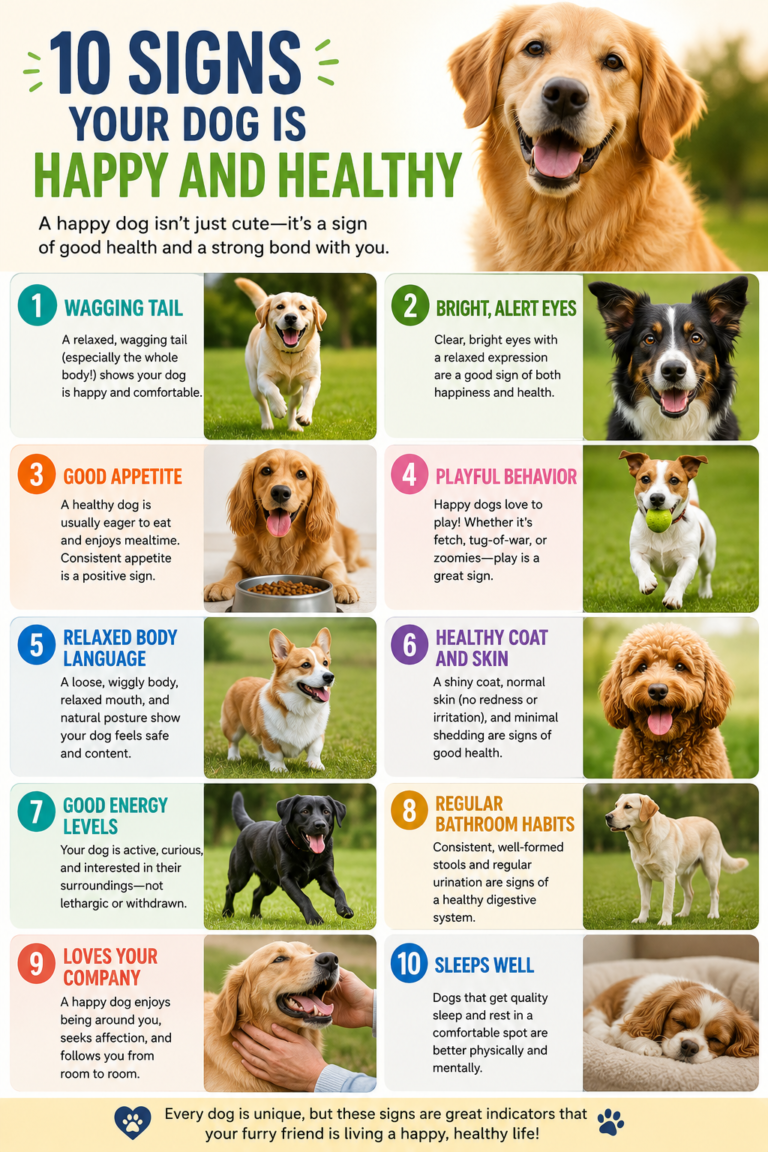
Have you ever looked over at your dog and thought, “I wonder if my dog is actually happy?”
If you have, you’re definitely not alone.
As dog parents, we spend a lot of time trying to figure out what our furry friends are thinking and feeling. We know when they want food, when they want to go outside, and when they’ve decided that our lap is the only acceptable place to sit. But, because dogs can’t simply tell us how they’re feeling, we have to pay attention to the little things.
Their behavior, appetite, energy, body language, sleeping habits, and even the way they greet us can tell us a lot.
Some signs of a happy, healthy dog are obvious. Others are much quieter, and easy to miss.
So, how do you know if your dog is doing well?
Here are 10 signs that your dog is happy and healthy, plus a few things worth watching for along the way.
1. Your Dog Gets Excited About Everyday Things
You know that moment when you pick up the leash, and suddenly, your dog is right beside you?
Or, when you open the treat cupboard, and your dog appears out of nowhere?
Dogs have a funny way of letting us know what they’re excited about.
A dog who is happy and feeling well will usually show some interest in what is happening around them. They may greet you when you come home, follow you into the kitchen, bring you a toy, or sit nearby while you’re working.
It doesn’t have to be constant excitement, either.
Some dogs are naturally energetic and playful. Others are calm, and perfectly happy spending most of the afternoon sleeping on the couch. Older dogs, in particular, may not have the same energy as puppies.
That’s why it’s so important to learn your dog’s normal personality.
If your normally enthusiastic dog suddenly stops wanting to go for walks, hides more than usual, or seems uninterested in the people and activities they normally enjoy, take notice.
A change in behavior doesn’t automatically mean something is seriously wrong, but it can be your dog’s way of telling you that something has changed.
2. They Have a Healthy Appetite
Most dogs take food very seriously.
You probably know exactly what happens in your house when the food bag comes out. Ears perk up, tails start moving, and somehow, your dog appears at your feet within seconds.
A healthy, consistent appetite is generally a reassuring sign.
Of course, every dog is different. Puppies may eat differently from senior dogs, and an active dog may have different nutritional needs than a less active one.
The important thing is knowing what is normal for your dog.
If your dog suddenly refuses food, starts eating significantly more than usual, or loses interest in meals for an extended period, it’s worth paying attention. The same goes for noticeable changes in thirst.
A temporary change may not be a big deal, but persistent changes should be discussed with your veterinarian.
And remember, a healthy appetite isn’t just about how much your dog eats. Their overall diet matters too. Your veterinarian can help you choose food and portion sizes that make sense for your dog’s age, size, activity level, and individual needs.
3. They Have Enough Energy to Enjoy Life
A happy dog usually has energy for the things they enjoy.
For one dog, that might mean racing around the backyard after a ball. For another, it might mean going for a leisurely walk, and stopping to sniff every tree along the way.
And then, there are the dogs who consider a five-minute game of fetch, followed by a three-hour nap, to be the perfect day.
There’s nothing wrong with that.
Dogs have different energy levels, and age makes a big difference. A young puppy may seem to have an unlimited supply of energy, while an older dog may naturally slow down.
What matters is whether your dog’s energy level seems normal for them.
If your usually playful dog suddenly becomes unusually tired, stops wanting to walk, or no longer seems interested in their favorite activities, keep an eye on the change.
If it continues, or you notice other unusual symptoms, contact your veterinarian.
4. Their Eyes Look Clear and Comfortable
Your dog’s eyes can tell you quite a bit.
Healthy eyes generally look clear and comfortable. Persistent redness, swelling, unusual discharge, frequent squinting, or constant rubbing at the eyes are things you shouldn’t ignore.
You may also notice that your dog’s whole expression changes when they’re relaxed.
Their eyes look soft. Their face isn’t tense. They may look at you calmly, before putting their head down for a nap.
Those quiet moments can be signs that your dog feels comfortable and safe.
On the other hand, if your dog’s eyes suddenly look different, or they start pawing at them, rubbing their face, or squinting frequently, it’s a good idea to have them checked.
Eye problems can sometimes become serious quickly, so unusual changes are worth taking seriously.
5. Their Coat and Skin Look Healthy
A shiny, well-maintained coat can be another encouraging sign of good health.
Of course, “healthy” looks different from one dog to another. A Labrador’s coat isn’t going to look anything like a Poodle’s, and a short-haired dog obviously won’t have the same kind of fur as a fluffy breed.
Instead of looking for a perfect coat, get familiar with your dog’s normal coat and skin.
Regular brushing and grooming are useful for more than making your dog look good. They give you a chance to notice things you might otherwise miss.
You may spot dry or irritated skin, unusual hair loss, parasites, lumps, or areas that seem painful when touched.
Your dog’s body weight is also important.
Carrying extra weight can put additional stress on the joints, and may contribute to other health problems. Being underweight can also be a concern.
If you’re unsure whether your dog is at a healthy weight, ask your veterinarian. They can assess your dog’s body condition, and help you determine what is appropriate.
And if your dog leaves a small mountain of fur on your sofa every week?
For many breeds, that’s just part of being a dog.
6. They Sleep Well and Know How to Relax
Dogs are professional sleepers.
Seriously, have you ever seen a dog fall asleep in the middle of a perfectly good afternoon?
Getting enough rest is an important part of a dog’s life. After exercise, play, or simply a busy day of being a dog, they need time to switch off.
A comfortable dog may curl up on their bed, stretch out on the floor, or find their favorite sunny spot, and settle down for a nap.
Being able to relax is especially important.
A dog who feels safe in their environment should generally be able to settle, rest, and sleep without constantly appearing anxious or uncomfortable.
Pay attention if your dog’s sleeping habits suddenly change.
Sleeping much more than usual, sleeping much less, or struggling to settle can sometimes signal that something isn’t quite right.
Of course, dogs naturally sleep a lot. The key is noticing a significant change from your dog’s usual routine.
7. They Still Enjoy Playing
One of the easiest ways to make a dog’s personality come alive is to bring out their favorite toy.
Maybe it’s a tennis ball.
Maybe it’s a rope.
Maybe it’s a squeaky toy that has somehow survived, despite your dog’s best efforts to destroy it.
Whatever their favorite happens to be, a dog who still shows interest in play is often showing that they’re feeling good.
Not every dog plays the same way. Some love chasing things. Others prefer tug-of-war. Some would rather spend their time sniffing around outside than chasing a ball.
Age matters, too.
A senior dog may play for five minutes, and then decide they’ve had enough. That doesn’t mean they’re unhappy.
The important thing is that they still show interest in activities they normally enjoy.
Play can also provide mental stimulation. A short game, a simple training session, or a puzzle toy can give your dog something interesting to think about during the day.
8. Their Body Language Looks Relaxed
Dogs are constantly communicating with us.
They use their ears, eyes, tails, posture, facial expressions, and movements to show us how they’re feeling.
Once you’ve lived with a dog for a while, you start picking up on these signals without even realizing it.
A relaxed dog often has a loose, comfortable body. Their face may look soft, their movements may be easy and natural, and their ears will usually sit in a position that is normal for their breed.
You might see them lying on their side, stretching out on the floor, rolling onto their back, or letting out a big sigh before settling down.
Those little moments can be wonderful signs that your dog feels comfortable in their surroundings.
But there’s one common misconception worth remembering:
A wagging tail doesn’t always mean a dog is happy.
Dogs wag their tails for many reasons. That’s why you should always look at the whole body, rather than focusing on the tail alone.
A dog with a loose body, relaxed posture, and gentle tail wag when you walk through the door is giving you very different signals from a dog whose body is stiff and tense.
Learning to read your dog’s overall body language can help you understand them much better.
9. Your Dog Enjoys Being Around You
Does your dog follow you from room to room?
Do they wait outside the bathroom?
Do they somehow know the exact moment you sit down, and immediately decide your lap belongs to them?
Dogs can be incredibly attached to their people.
Many dogs enjoy staying close to the humans they trust. They may greet you enthusiastically when you come home, curl up beside you, or simply choose to sleep in the same room.
But not every dog is a clingy dog.
Some are independent, and prefer having their own space. Others want to be touching you at all times.
Neither is necessarily a sign of greater happiness.
What matters is whether your dog feels comfortable around you.
Do they approach you willingly?
Do they relax when you’re nearby?
Do they come to you when they want something?
Are they comfortable sleeping around you?
These ordinary interactions can tell you a lot about your relationship.
And honestly, your dog doesn’t need an expensive toy collection, or a perfectly planned adventure every weekend.
Sometimes, happiness looks much simpler.
A full bowl.
A good walk.
A favorite toy.
A safe bed.
And you sitting nearby.
10. They’re Curious About the World
Dogs are naturally curious.
Take them for a walk, and they may spend ten minutes investigating the same patch of grass as though they’ve just discovered something extraordinary.
Bring a new object into the house, and suddenly, they need to inspect it.
Hear a strange noise outside?
They’re on the case.
That curiosity is a healthy part of being a dog.
A dog who enjoys sniffing, exploring, watching what’s happening around them, and investigating new smells and sounds is often mentally engaged with their environment.
You can encourage that curiosity in simple ways.
Take a different walking route from time to time. Let your dog spend a little extra time sniffing when it’s safe. Try a scent game, or introduce an age-appropriate puzzle toy.
For dogs, walks aren’t just about exercise.
Their noses are doing a huge amount of work. Every smell gives them information about the world around them.
So, the next time your dog stops for what feels like the hundredth sniff of the same tree, remember: they may be getting a lot more out of that moment than you are.