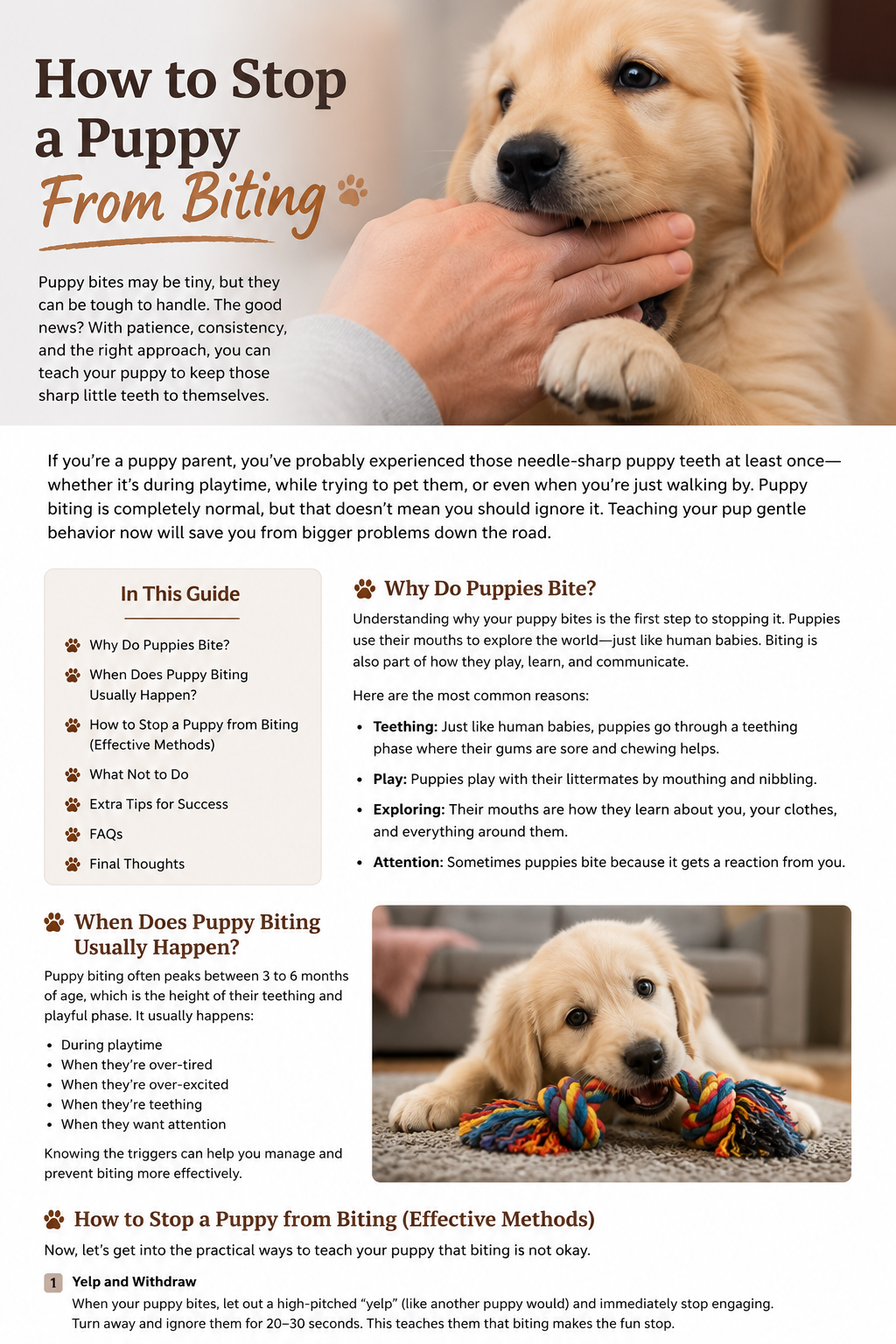
How to Stop a Puppy From Biting: 10 Simple and Gentle Training Tips
Bringing home a new puppy is exciting. Those tiny paws, playful eyes, and wagging tail can make you fall in love almost instantly.
Then come the teeth.
Your adorable puppy starts biting your fingers, grabbing your clothes, chewing your shoes, and chasing your ankles whenever you walk past. You may find yourself asking, “How do I stop my puppy from biting?”
The good news is that puppy biting is a normal part of growing up. Puppies use their mouths to explore, play, communicate, and deal with the discomfort of teething. However, that doesn’t mean you have to accept painful biting forever.
With patience, consistency, and the right training approach, you can teach your puppy to bite less and interact with people more gently.
In this guide, we’ll explain how to stop a puppy from biting, why puppies bite in the first place, what to do when your puppy bites, common mistakes to avoid, and when you may need professional help.
Why Do Puppies Bite?
Before you can stop puppy biting, it helps to understand why your puppy is doing it.
Your puppy isn’t trying to be naughty or make you angry. They’re still learning how the world works.
Here are some of the most common reasons puppies bite.
1. Puppies Explore With Their Mouths
Puppies are naturally curious.
They smell, touch, taste, and investigate almost everything around them. Since they don’t have hands like humans do, their mouths become an important way of exploring their surroundings.
That’s why your puppy may chew your fingers, pick up objects from the floor, or bite your shoes.
To a young puppy, your hand may seem like just another interesting thing to investigate.
Your job is to teach them that human hands are different from chew toys.
2. Teething Makes Puppies Want to Chew
Teething is one of the biggest reasons puppies chew and bite.
As their baby teeth fall out and adult teeth come in, their gums can become sore and uncomfortable. Chewing can provide something interesting to focus on and may help soothe their gums.
During this stage, make sure your puppy has several safe, age-appropriate chew toys.
Instead of constantly telling your puppy what they can’t chew, give them something they are allowed to chew.
3. Puppies Bite During Play
Watch a group of puppies play, and you’ll notice that biting is a normal part of their interaction.
They chase each other, wrestle, grab, and gently bite.
Your puppy may assume that humans want to play the same way.
If you regularly let your puppy chase your hands or bite your fingers during play, they may learn that biting people is part of the game.
It may seem cute when they’re tiny, but those little teeth won’t stay tiny forever.
4. Your Puppy May Be Overexcited
Sometimes puppy biting happens because your dog is simply too excited.
This is common during energetic play. Your puppy may start jumping, running around, grabbing your clothes, and biting your hands.
At this point, they may have difficulty calming themselves down.
An overtired puppy can behave much like an overtired child. Instead of needing more excitement, they may need a quiet break and some sleep.
5. Puppies Need to Learn Bite Inhibition
Bite inhibition means learning to control how hard they bite.
Young puppies often learn this skill while playing with their mother and littermates. If a puppy bites another puppy too hard, the other puppy may yelp and stop playing.
Over time, the puppy learns that biting too hard ends the fun.
Your puppy also needs to learn that people have sensitive skin and that rough biting isn’t an appropriate way to interact.
How to Stop a Puppy From Biting
Now that you know why puppies bite, let’s look at what you can actually do.
The goal isn’t to punish your puppy for using their mouth. Instead, you want to teach them what they should chew, how they should play, and how to interact gently with people.
1. Redirect Your Puppy to a Toy
One of the simplest ways to stop puppy biting is to redirect your puppy toward something appropriate.
If your puppy bites your hand, calmly move your hand away and offer a toy.
A rope toy, puppy-safe chew toy, or another appropriate toy can give your puppy something they are actually allowed to bite.
When your puppy starts chewing the toy instead of your hand, praise them.
You’re teaching them a simple lesson:
“This is okay to chew. People are not.”
You may need to repeat this many times.
That’s normal.
Puppies learn through repetition and consistency.
2. Stop Playing When Your Puppy Bites Too Hard
If your puppy keeps biting during play, calmly end the game.
Stop moving the toy, remove your attention, and give your puppy a moment to settle.
You don’t need to shout or scare them.
Your puppy can gradually learn that rough biting makes the fun stop.
This works because most puppies love attention and interaction. When biting causes the game to disappear, they have a reason to try a different behavior.
3. Don’t Use Your Hands as Toys
If you’re wondering how to teach a puppy not to bite, start by looking at the way you play with them.
It can be tempting to wrestle with a puppy using your hands. However, doing this can send a confusing message.
If your puppy is allowed to chase and bite your fingers during one game, they may not understand why biting your hands is suddenly unacceptable later.
Instead, use toys for energetic games.
Tug toys, balls, and puppy-safe toys can give your puppy plenty of fun without encouraging them to bite human hands.
4. Reward Gentle Behavior
Training isn’t only about correcting unwanted behavior.
You also need to show your puppy what you want them to do.
If your puppy approaches you without biting, praise them.
If they lick your hand instead of grabbing it, reward them.
If they sit calmly while you pet them, give them positive attention.
These small moments are valuable.
Your puppy begins to understand that calm and gentle behavior gets rewarded.
The more often you reward behavior you like, the more likely your puppy is to repeat it.
5. Provide Plenty of Safe Chew Toys
A puppy needs appropriate outlets for chewing.
If you don’t give them something interesting to chew, they may find something themselves.
Unfortunately, that might be your favorite shoes, furniture, or even the corner of your carpet.
Keep several safe puppy chew toys available and rotate them regularly so they remain interesting.
Food-stuffed toys and other appropriate enrichment activities can also help keep your puppy occupied.
Always choose toys that are suitable for your puppy’s age, size, and chewing habits. Check toys regularly, and replace them if they become damaged.
6. Make Sure Your Puppy Gets Enough Sleep
This is one of the most overlooked puppy training tips.
Young puppies need plenty of sleep.
When they’re tired, they don’t always become calm and sleepy. Some puppies become even more energetic, restless, and bitey.
If your puppy suddenly starts biting everything after a busy period, consider whether they’re actually overtired.
Sometimes, what looks like a training problem is simply a tired puppy who needs some quiet time.
A consistent routine that includes meals, potty breaks, play, training, and naps can help your puppy learn when it’s time to be active and when it’s time to relax.
7. Use Short Training Sessions
You don’t need to spend hours training your puppy.
In fact, young puppies often learn better through short and positive training sessions.
Practice simple behaviors such as:
- Sit
- Stay
- Come
- Leave it
- Drop it
- Gentle greetings
When your puppy listens and behaves appropriately, reward them.
Teaching basic commands gives your puppy something else to focus on when they’re excited and can make everyday situations easier to manage.
8. Teach Your Puppy That Biting Ends Attention
If your puppy bites you during a calm interaction, avoid turning it into a dramatic event.
Calmly remove your attention for a short moment.
Then, once your puppy is calm, try interacting again.
The message is simple:
Biting makes attention stop. Calm behavior makes attention continue.
Be consistent with this lesson. If biting sometimes gets a reaction and sometimes doesn’t, your puppy may become confused.
9. Manage Your Puppy Before They Become Too Excited
Prevention can make puppy training much easier.
If you know your puppy becomes especially bitey during certain situations, try to manage those moments before they get out of control.
For example, if your puppy becomes wild after a long play session, finish the game earlier and give them time to rest.
If they bite when visitors arrive, have a toy ready before the door opens.
If they attack your ankles while you’re walking around the house, keep a toy nearby so you can redirect them quickly.
The goal isn’t to control every move your puppy makes. It’s to make good choices easier for them.
10. Be Patient and Consistent
This may be the most important tip of all.
You probably won’t stop puppy biting in one afternoon.
There may be days when your puppy seems to understand everything, followed by another day when they bite your hands constantly.
That’s normal.
Puppies are still developing, learning, and adjusting to their environment.
Focus on progress instead of perfection.
If your puppy is biting less often, responding to redirection more quickly, or becoming calmer during play, you’re moving in the right direction.
How to Stop a Puppy From Biting Your Hands
Hand biting is one of the most common complaints from new puppy owners.
When your puppy bites your hand, avoid quickly pulling your hand away if that movement makes the puppy chase it.
Instead, calmly remove your hand, pause the interaction, and redirect your puppy toward an appropriate toy.
You can also reward your puppy when they allow you to touch or pet them without biting.
With repetition, your puppy can learn that hands are for gentle interaction, while toys are for chewing and tugging.
How to Stop a Puppy From Biting Your Ankles
Ankle biting can be especially annoying.
You’re simply walking across the room, and suddenly your puppy is chasing your feet.
The natural reaction is to move faster, but that can accidentally turn the situation into a fun chasing game.
Instead, stop moving if you can do so safely.
Stay calm, redirect your puppy to a toy, and reward them when they engage with the toy instead.
Also, pay attention to when the ankle biting happens.
Does it happen in the evening? After a long play session? When your puppy hasn’t had much attention?
Finding the pattern can help you understand what your puppy needs.
How to Stop a Puppy From Biting Clothes
Some puppies love grabbing pants, socks, sleeves, and other pieces of clothing.
If your puppy grabs your clothes, avoid turning it into a tug-of-war.
Instead, calmly redirect them to a toy.
You can also teach commands such as “drop it” and “leave it” using positive reinforcement.
Keeping tempting clothing items out of reach can help while your puppy is still learning.
Remember, prevention is part of training.
What Not to Do When Your Puppy Bites
When you’ve been bitten repeatedly, it’s understandable to become frustrated.
However, some common reactions can make the situation worse.
Don’t Hit Your Puppy
Physical punishment can make your puppy afraid of you and damage the trust you’re trying to build.
Your puppy should learn that you are a safe person.
Don’t Yell at Your Puppy
A loud reaction may not teach your puppy what you want.
Some puppies may even find the reaction exciting because it gives them attention.
A calm, consistent response is usually more helpful.
Don’t Chase Your Puppy
If your puppy grabs a sock and you chase them around the house, they may think you’ve started a fantastic new game.
Instead, calmly trade the item for an appropriate toy when possible.
Don’t Expect Instant Results
Puppy training takes time.
Your puppy won’t necessarily stop biting after one training session.
Consistency matters much more than perfection.
When Should You Be Concerned About Puppy Biting?
Most puppy biting is normal.
However, you should take the behavior more seriously if the biting seems unusually intense, regularly causes injuries, or happens alongside signs of fear or aggression.
Pay attention to other behaviors, such as stiff body language, guarding food or objects, persistent growling, or reactions that seem very different from normal playful puppy behavior.
If you’re unsure whether your puppy’s behavior is normal, speak with your veterinarian or a qualified positive-reinforcement dog trainer.
Getting help early can make puppy training much easier.
How Long Does Puppy Biting Last?
Many new puppy owners wonder, “When will my puppy stop biting?”
Unfortunately, there isn’t one exact age when every puppy stops.
Every dog is different.
Teething, personality, breed tendencies, environment, sleep, exercise, and training can all affect how long puppy biting lasts.
The important thing is to remain consistent.
You may notice that your puppy gradually bites less, redirects to toys more quickly, and becomes better at controlling their mouth.
Those are all signs of progress.
As your puppy grows, matures, and learns appropriate behavior, the constant biting should gradually become less of a problem.
Frequently Asked Questions About Puppy Biting
Is it normal for puppies to bite?
Yes. Puppy biting is a normal part of development. Puppies use their mouths to explore, play, communicate, and deal with teething. However, they still need to learn that biting people isn’t appropriate.
What is the fastest way to stop a puppy from biting?
There isn’t a magic overnight solution. One of the most effective approaches is to consistently redirect your puppy toward appropriate toys, stop attention when biting becomes too rough, and reward calm, gentle behavior.
Should I say “ouch” when my puppy bites me?
Some puppies respond to a brief, calm reaction, while others become more excited when they hear a loud sound. If saying “ouch” makes your puppy more excited, stop using it and calmly end the interaction instead.
Should I punish my puppy for biting?
Harsh punishment isn’t recommended. Hitting, yelling, or frightening your puppy can damage your relationship and may create fear. Positive reinforcement, redirection, and consistent boundaries are better ways to teach appropriate behavior.
How do I stop my puppy from biting my hands?
Avoid using your hands as toys. When your puppy bites your hand, calmly remove it and redirect your puppy to an appropriate toy. Reward your puppy whenever they interact with you gently.
Why does my puppy bite my ankles?
Puppies may bite ankles because moving feet trigger their natural desire to chase and play. They may also do it because they’re excited, bored, or overtired. Stop moving when possible, redirect them to a toy, and reward calm behavior.
Do puppies grow out of biting?
Many puppies become much less bitey as they mature and learn appropriate behavior. However, they still need guidance. Consistent training, appropriate chew toys, rest, and positive reinforcement can help them develop good habits.